I’ve Got the Joy, Joy, Joy, Joy. . . Where?!

If you’re a little short on joy this week, make a withdrawal from your memory bank.
October is almost here—nearly time for our First Friday book giveaway! Watch for our monthly “Shelf Indulgence” this Friday featuring a new Bible study on Ruth, and a thoughtful resource on walking in the power and presence of the Holy Spirit.
I was rummaging for an item in a bureau drawer when a photo fell out—an old Kodacolor print from an Easter Sunday in the 1960’s of an eleven-year-old girl flanked by two Sunday school classmates.
The boys, hair closely buzzed into crewcuts, squint into the after-church sun, awkward in seldom-worn jackets and ties. The girl looks uncomfortable too – her mustard-color wool coat swamping a skinny frame, toothpick legs straddling a drainpipe.
I sat back on my heels, studying the photo, smiling in recognition.
There you are! I thought. Look at you with that mop of dishwater blonde curls spilling over those thick cats-eye spectacles. Next to your pretty mama and your tall, blossoming older sister, you were such a homely little thing.
I never spoke to my geeky boy classmates if I could help it, but we grew up together in the only Protestant church in a tiny Illinois village. We cut out pieces of cloth fruit and Bible characters and attached them to a flannelgraph board. We joined other classes for songs during opening exercises, springing up from cold metal folding chairs whenever we got to the big question:
“I’ve got the joy, joy, joy, joy
Down in my heart.
Where?
Down in my heart.
Where?
Down in my heart!
I’ve got the joy, joy, joy, joy
Down in my heart.
Down in my heart to stay!”
To my childhood self, joy wasn’t a scriptural truth but a Sunday-school scene: flannelgraph grapes and rowdy boys shouting ‘Where?’ so loudly that Mrs. Allen, the preacher’s wife, had to shush them.
Though I didn’t understand the biblical concept of joy, I lived it.
I loved growing up on a farm, shielded as I was from adult responsibilities. My Norwegian grandparents couldn’t afford to purchase land after they immigrated, so they labored as modern sharecroppers—the landlord taking half of whatever profit crops and livestock brought in.
When they died far too young, their oldest child of five—my father—dropped out of university to keep the farm going and care for his youngest brother still at home.
As the new tenants, my parents worked sunup to sundown six days a week, but other than a few chores, I was free to roam. I attended a consolidated elementary school with four classrooms, 18 students and oddly enough, no friends. I only recall being invited to a classmate’s home once.
I truly did not mind.
It was as if I was invisible, a sort of superpower that let me live under the radar where I escaped the notice of just about everybody, including the class bully and even my teachers, who were generous with knowledge but stingy with praise.
Yet as I look back, I remember only the joy of romping with my collie, picking beans and sweet corn in the garden, herding sheep with my father. I lived within the pages of books and my vivid imagination.
When hard times came, I knew where to turn—God and my parents. And as I’d learned to sing in Sunday school, “If the devil doesn’t like it he can sit on a tack”—the worst punishment Christian kids were allowed to wish on anyone.
When I left for college at 18, I climbed up into my old tree fort and left a note in a knothole for my future self. I always intended to go back one day and see if it’s still there. After over a half-century, the paper has surely deteriorated, the writing faded. It was only three words, after all.
I’m a grownup girl now. The farm hundreds of miles north is under new ownership.
But when I need a dose of joy, I visit my childhood home in my mind. Writing stories on the porch. Running through the fields. Recalling the pure joy of being invisible to the world, free of responsibility and expectations and notice.
While on a women’s retreat last week, I visited Carl Sandburg’s home in nearby Flat Rock. The Pulitzer Prize—winning “People’s Poet,” a native of Illinois, was one we claimed as our own in my rural school where we memorized "Chicago” and “Fog.”
But it’s a line from Sandburg’s poem “Joy” that I keep above the desk in my present-day writing cabin.
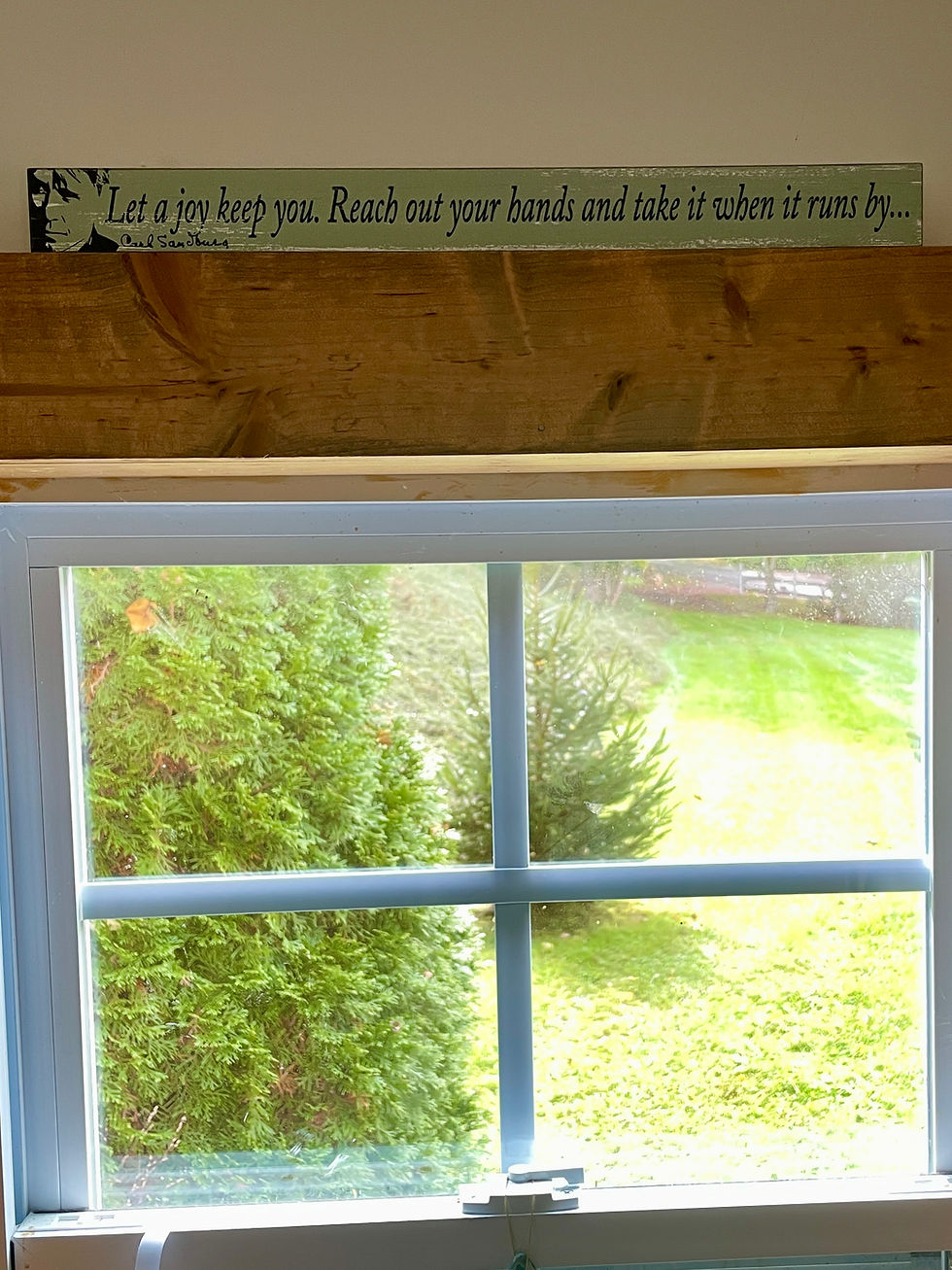
“Let a joy keep you. Reach out your hands and take it when it runs by. . .” Carl Sandburg
Joy is ours for the taking, friends. Reach out and seize it. Sit with happy memories for a while. And if the devil doesn’t like it, you know just what he can do.
As for the note I left in my tree fort decades ago? Just three words: I remember you.
I remember.
With love,
Maggie
[Need a smile today? Please sing along!]
IT’ S YOUR TURN. What’s one memory from your distant or recent past that brings you joy when you revisit it?